English
Body
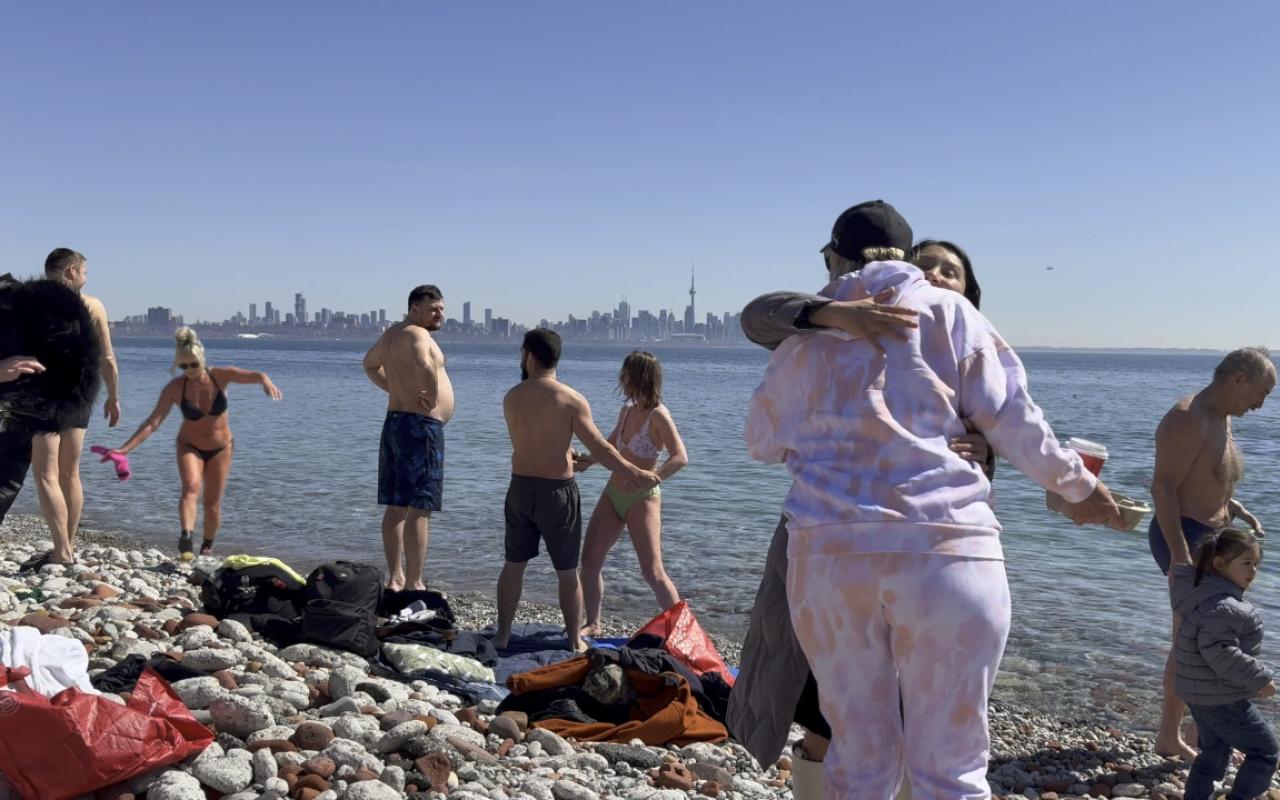
World Tour event in Georgia.

Georgia is one of the 50 countries participating in the Banff Centre Mountain Film Festival World Tour.

The Banff Centre Mountain Film Festival World Tour is screened around the world in more than 450 destinations in 50 countries.

For some countries, given political and other circumstances, hosting an event like the Banff Mountain Film World Tour is extra complicated.

This year, we wanted to recognize some of our tour hosts who bring these stories of resilience and passion to their communities, reminding us of the power of story, adventure, nature, and connection.

We reached out to Frida Ayala (Venezuela), Jeremy Gaskill (Georgia) and Muntasir Mamun (Bangladesh) to hear their stories about what hosting a World Tour event means to them.

How did you start working with the festival as a Tour Host?

Frida: “In 2002, my late husband was climbing Huascaran. He stayed in Huaraz and saw a poster for the BMFF. He came home very excited because he thought the idea of ​​a mountain film festival was wonderful… He decided to bring the festival to Venezuela [and] we had our first festival in 2003.

Jeremy: “[My wife] and I had attended Banff Mountain Film Festivals for years… When we later returned to Georgia, we reconnected with Paul, who had also been a Peace Corps Volunteer here [and] the idea of Banff just clicked for us.”

Muntasir: “2003, I went to Everest Base Camp and had the pleasure of meeting Christopher York who suggested that I explore the Banff Mountain Film Festival. In 2005, I sent my first email to Jim Baker, the festival’s world tour manager.”

Why did you want to bring the tour to your country?

Frida: “The first motivation was… to reinforce the bonds among the mountaineering, rock climbing and outdoor sports in Venezuela with the world. Right now, the festival is an opportunity to bring hope, resilience, a sense of freedom and the right to dream of a better world.”

Jeremy: “[We] knew what significant role mountains play in Georgia’s culture and felt that the festival belonged here. We saw Banff as a way of tapping into [a growing enthusiasm for mountain sports] and of inspiring new possibilities.”

Muntasir: “I wanted to introduce the Tour here to spark passion and curiosity about the world beyond our borders; to show that adventure is not just for explorers from faraway lands, but something we all can experience and be a part of. It’s also a way to… encourage [environmental preservation] through storytelling.”

What challenges (if any) have you experienced hosting? And how have you overcome them?

Frida: “In 2006 my husband and partner died coming down from Nanga Parbat, so I had to carry the responsibility of doing the fest and raising my little children. In 2014 and 2018 we [had] the most difficult political problems, fights in the streets, and a crazy economy. [That year], we went to the venue to cancel [and] found 100 people begging us to [stay open]. Years have passed, many have left the country, and [gaining] a new audience has been an issue. This has been one of the most difficult years due to the economic crisis and political and social instability.”

Jeremy: “In April, the Georgian government announced plans to introduce the ‘Foreign Influence Transparency Law.’ As a result, huge, sustained protests erupted across the country, particularly in Tbilisi. Understandably, the law and the upcoming October elections [are] the primary focus for many Georgians. While the Mountain Film Festival is important to us, we recognize that it doesn’t carry the same weight as these larger, critical challenges. For now, we have just postponed this year’s Festival and we remain hopeful.”

Muntasir: “Securing funding. [The screenings are free, so] securing sponsorships has been particularly difficult, as the festival is niche and not considered a mainstream film event."

What value do you feel the tour brings to your community? 

Frida: “Hope!”

Jeremy: “New inspiration, broader perspectives, and a deeper appreciation for the beauty of nature.”

Muntasir: “Motivation; igniting a passion for outdoor activities, conservation efforts, and personal growth.”

Why do you think it is important to celebrate and showcase mountain culture in your community?

Frida: “People also come here who find a message of values ​​and possibilities that they want to confirm in their lives. Many start doing outdoor activities after experiencing the festival.”

Jeremy: “By showcasing mountain culture through the eyes of others…, we can reawaken Georgians' appreciation for their own country and deepen their understanding of what’s possible.”

Muntasir: “In Bangladesh, while many live near the poverty line, that doesn’t diminish their passion for adventure or the dreams they hold. The festival creates a space where adventure is celebrated in all its forms, and where everyone is reminded that the spirit of exploration and discovery is universal.”

Author: Akcinya Kootchin, Banff Centre for Arts and Creativity

Located in the Canadian Rocky Mountains, the Banff Centre Mountain Film and Book Festival is a globally recognized event and tour celebrating the beauty, adventure, and culture of mountains globally. Join us at Banff Centre for Arts and Creativity from November 1 – 9, 2025 for the 50th Anniversary of the Festival in Banff, Alberta! The nine-day festival showcases live events with adventurers, authors, photographers, and filmmakers sharing their inspiring stories.

Online films are also available to watch throughout the year on Banff on Demand.  
To find out more about the Festival, World Tour, and related programs, please visit banffcentre.ca/banffmountainfestival

Page Summary
Hosts Frida Ayala, Jeremy Gaskill and Muntasir Mamun share their stories and experiences of what is like to host a World Tour event.
Feature Image
Georgia-8_compressed.jpg
Contact Text Block

Media Contact

Interested in reporting on this or any other Banff Centre story? Members of the media can reach out to communications@banffcentre.ca for more information.

Hide Sidebar
Off
English
Body
The expedition team climbs towards camp 1 on Mt. Logan in Kluane National Park and Reserve. Credit: Leo Hoorn/National Geographic

The expedition team climbs towards camp 1 on Mt. Logan in Kluane National Park and Reserve. Credit: Leo Hoorn/National Geographic

In 2022, National Geographic Explorer and ice core scientist Alison Criscitiello led a team of international scientists on a daring expedition to climb Mount Logan – a long and arduous ascent which 50% of climbers don’t complete. The team braved -20 to -40 C temperatures, strong winds, complex icefalls, and intense snowfall to reach the summit plateau and successfully extract an ice core from the mountain.

The ice core holds critical historical climate data that could reveal how the region may respond to future change. This information is vital to studying the climate, especially as our planet warms.

Criscitiello’s herculean effort is part of Perpetual Planet Expeditions, a partnership between the National Geographic Society and Rolex to document the impacts of climate and environmental change on our planet’s vital life support systems.

The expedition was documented and made into a film by the Society’s Impact Story Lab, an award-winning creative unit that combines world-class storytelling with social and behavioral science in order to drive positive change. The documentary, For Winter, captures the ascent as well as Criscitiello’s home life, and what it’s like to balance the demands of her job with kids as well as being a LGBTQ+ woman in STEM.

Criscitiello is the Director of the Canadian Ice Core Lab at the University of Alberta and co-founder of Girls on Ice Canada, a tuition-free program that supports the next generation of female scientists and mountaineers.

She hopes the film inspires people to focus on the solutions to mitigate against climate change.

“In my position, I hear a lot of climate anxiety and despair. It’s time to feel the opposite and do the opposite. This is the time to make the change.”

This particular climb of Mount Logan was record breaking. Criscitiello collected the deepest non-polar ice core ever collected at an altitude over 17,000 feet. In addition, Mount Logan is the highest peak in Canada.

The film’s executive producer and vice president of the Society’s Impact Story Lab, Vanessa Serrao, said she hopes the film shifts the narrative of science, exploration and conservation to foster a more inclusive community. In fact, the film is named after Criscitiello’s three-year-old daughter, Winter, and showcases the hope that she too can do anything — even the seemingly impossible.

“Alison’s story shows that this is not only possible, but necessary. We all have a place in solving the planet’s most pressing issues,” said Serrao.

Author: Porter O'Brien Agency 

National Geographic Explorer Alison Criscitiello holds a portion of her 2022 Mt. Logan ice core in the Canadian Ice Core Lab at the University of Alberta. Credit: Leo Hoorn/National Geographic

National Geographic Explorer Alison Criscitiello holds a portion of her 2022 Mt. Logan ice core in the Canadian Ice Core Lab at the University of Alberta. Credit: Leo Hoorn/National Geographic

Located in the Canadian Rocky Mountains, the Banff Centre Mountain Film and Book Festival is a globally recognized event and tour celebrating the beauty, adventure, and culture of mountains globally. Join us at Banff Centre for Arts and Creativity from November 1 – 9, 2025 for the 50th Anniversary of the Festival in Banff, Alberta! The nine-day festival showcases live events with adventurers, authors, photographers, and filmmakers sharing their inspiring stories.

Online films are also available to watch throughout the year on Banff on Demand.  
To find out more about the Festival, World Tour, and related programs, please visit banffcentre.ca/banffmountainfestival

Page Summary
For Winter is a new documentary focused on the journey of Alison Criscitiello, who climbed Mount Logan to uncover climate history via ice cores.
Feature Image
NS120363601_NGSPPMTL2022_Leo Hoorn_NGS22007-11-8474_ NEW.jpg
Contact Text Block

Media Contact

Interested in reporting on this or any other Banff Centre story? Members of the media can reach out to communications@banffcentre.ca for more information.

Hide Sidebar
Off
English
Body
Alex Honnold and Greg Child arm wrestle at Banff Centre

Here are some momentous milestones, key dates, and fun adventures we’ve had over the past 50 years during the Banff Centre Mountain Film and Book Festival! There are literally mountains of memories, but here are a few to share with you for a little journey down memory lane: 


1970s


1976 Bored climbers Chic Scott, Patsy Murphy, Evelyn Moorehouse, and Betty Ware scheme about a mountain film festival in a Banff basement. John Amatt helps them turn their dream into reality and the first festival is held.
1976 The first Festival is held on October 31, 1976. 
1977 The first film competition opens, with 19 entries submitted. 
1978 The Festival becomes a two-day event.


1980s


1981 Best of the Festival Film Tour is launched in partnership with Alpine Club of Canada sections from Ottawa to Victoria. 
1984 Austrian Mountaineer Peter Habeler does a presentation about his and Reinhold Messnerʼs first oxygenless ascent of Everest/Chomolungma.
1987 Introduction of the Summit of Excellence Award. Local photographer Bruno Engler wins.
1988 Bernadette McDonald takes the helm as Festival Director. 
1989 Sir Chris Bonington opens the Festival as guest speaker.


1990s


1990 The Best of the Festival Tour expands from three cities to 38 screenings and 27 cities in Canada and the United States.
1994 The Book Festival is established, and is presented alongside the Film Festival.
1994 UK climber Alison Hargreaves presents Six North Faces of the Alps,  her record-breaking project. She dies tragically the following year on K2.
1996 Catherine Destivelle charms the Banff audience with recollections of her multi-day solo ascents in the Alps. 
1999 “Radical Rides” becomes the Festival's first strictly high-adrenaline program, the prescursor to what is now Radical Reels.


2000s


2000 The Festival celebrates 25 years, hosting a huge event including a mountaineers’ summit. In partnership with National Geographic, the Festival publishes Voices From the Summit: The World’s Great Mountaineers on the Future of Climbing.
2001 The Adventure Filmmakers Workshop is launched as a two-day program.
2003 The Book Festival lineup features Peter Matthiessen and Maria Coffey. Mountaineering classic Touching the Void screens.
2005 The first three-week Mountain Writing Program residency is established.
2009 Canmore filmmaker Leanne Allison presents her film Finding Farley along with husband and adventure partner Karsten Heuer. It wins both People’s Choice and Grand Prize.

2010s


2010 Free soloist Alex Honnold appears on the Banff stage for the first time along with climber Peter Croft.
2012 The first woman to ascend all 8000-metre peaks without supplemental oxygen, Gerlinde Kaltenbrunner, takes to the Banff stage. 
2015 Climbers Alex Honnold and Greg Child arm wrestle on stage during their interview. 
2016 Writer and adaptive climber Paul Pritchard is featured in the annual Voices of Adventure interview. 
2019 The Festival Marketplace moves to the Kinnear Centre, and doubles in size by 2023.

2020s


2020 The Festival pivots to online during the COVID-19 pandemic. The Banff on Demand streaming platform is launched.
2023 Snowboarders Jeremy Jones and Jess Kimura are featured as keynote speakers.
2024 Climber Beth Rodden is interviewed on stage about her book A Light Through the Cracks: A Climber’s Story. At intermission, hundreds of book lovers wait patiently as Rodden signs copies well into the night.
2025 
Celebrating 50 Epic Years! With an attendance of over 21,000 in Banff! 
Fire and Ice Symposium: The Stories We Tell is held in collaboration with the UN International Year of Glaciers’ Preservation.
 

Page Summary
Find out more about momentous milestones, key dates, and fun adventures we’ve had over the past 50 years during the Banff Centre Mountain Film and Book Festival
Feature Image
TIMELINE_Alex Honnold and Greg Child arm wrestle by Rita Taylor.jpg
Contact Text Block

Media Contact

Interested in reporting on this or any other Banff Centre story? Members of the media can reach out to communications@banffcentre.ca for more information.

Hide Sidebar
Off
English
Body
Large ice cave with cameraman filming an aerial performer

By Trixie Pacis

From Adventure Filmmakers Workshop to Documentary Director

A few winters ago, I found myself in the charming mountain town of Kimberley, BC. Ski slopes without lift lines replaced the hustle of the Vancouver film industry, where I had worked my way from assistant roles into script development. To stay in Kimberley would require a career shift—and this is precisely when I chanced upon an ad for the Banff Centre Adventure Filmmakers Workshop (AFW). 


The Adventure Filmmakers Workshop is a 10-day intensive designed for independent and emerging filmmakers. Over its 20-year tenure, it has drawn 400+ participants from across the globe. 


Though typically held in tandem with the Banff Centre Mountain Film and Book Festival, I was part of a virtual cohort in the spring of 2021. Benefits of this post-pandemic workshop included skiing resort laps before dashing to my desk with a goggle tan. More importantly, the workshop was a beacon of inspiration during an otherwise bleak spring. It single-handedly drew me into the world of documentary filmmaking.


Over a dozen sessions, I took meticulous notes as faculty Keith Partridge and Michael Brown dove into every detail of documentary filmmaking. I bolded words of wisdom like, “Have a north star”... “If it’s fluffy, stay wide. If it’s getting serious, push in”... “Silence is important too”... and “Interviews are about connecting as a human being to another human being”— ideas now integral to my approach. To balance film theory, we were tasked with making a short film. I collaborated with two classmates to capture the joy of cross country skiing felt by characters of all ages and abilities.  


The workshop culminated in a practice pitch. New to the Canadian Rockies and its history, I was intrigued by early 1900s artist and adventurer Mary Schäffer Warren. I pitched a film about her contributions to wilderness exploration. I didn’t know the idea would take root and eventually blossom into my directorial debut: a 37-minute film called Wildflowers.


In a full-circle moment, Wildflowers had its world premiere at the 2024 Banff Centre Mountain Film and Book Festival. My second film Wild Aerial premiered too. Some of my workshop classmates sat in the audience. Keith and Michael could not attend—they were teaching the workshop in the building next door—but we later toasted to the community and sense of self-belief this workshop cultivates. 


Reflecting on my transition into mountain culture documentaries, I realized I had found my north star. Thanks in part to Keith and Michael’s continued mentorship and new partnerships cemented at the 2024 Festival, I’ll be back in 2025 to celebrate Banff’s 50th anniversary and premiere my fourth film Embers. November may be shoulder season in the Rockies but the month is sacred. Both the Festival and AFW offer unparalleled opportunities to gather with like-minded creatives, immerse in mountain stories, and feel the stoke.

Find out more about the Adventure Filmmakers Workshop and Moonlighter Film Camps at Banff Centre for Arts and Creativity.

Page Summary
From participating in the Adventure Filmmakers Workshop to becoming a documentary director, filmmaker Trixie Pacis shares her own Banff journey. Read more
Feature Image
DSCF0303 - From Wild Aerial Photo by Aidan Lee.jpg
Contact Text Block

Media Contact

Interested in reporting on this or any other Banff Centre story? Members of the media can reach out to communications@banffcentre.ca for more information.

Hide Sidebar
Off
English
Body
Snowy mountain landscape

By Michael Kennedy

I was broken when I came to Banff Centre for the Mountain and Wilderness Writing program (now called Mountain Writers Intensive) in October 2019. Our son Hayden had died by suicide two years before. I wanted to write a memoir but had no idea of how to approach such a daunting task. All my previous writing had been prosaic, a workmanlike procession of news, editorials, book reviews, and features produced during my twenty-four years as editor of Climbing Magazine. How could I turn a few vague ideas into a book that made sense of the twenty-seven years my wife Julie and I had shared with Hayden, and the devastation his death had wrought?

Those three weeks in Banff were a godsend. Under the able and sympathetic guidance of faculty members Marni Jackson, Tony Whittome, and Harley Rustad, I was able to put together the first few chapters and develop a rough plan for the rest of the book. The other writers in the workshop were extraordinarily diligent and thoughtful in their close reading of the work we shared with each other.

At the end of our three weeks together it seemed a shame to say goodbye. Several of us have continued meeting online in the years since; this group’s feedback and support have been essential to my ability to tackle the most challenging writing I’ve ever attempted. More importantly, we’ve developed the kind of lifelong friendships that only come from sharing our most profound experiences, our fears, and frustrations, and our infrequent moments of transcendence.

It would be easy to attribute the synergy I experienced in 2019 to the personal chemistry among this group of people. But there seems to be something else at work, a particular mix of place, spirit, and intention unique to Banff Centre. That hint of magic while walking across campus at midnight as falling snow glimmers in lamplight, engaging in an unexpected breakfast conversation at Vistas, catching a raven in flight over the Bow River valley from the Tunnel Mountain trail. There is an “aha” moment sparked by a fellow writer’s question that clarifies the path you’ve been missing, while tapping into the vitality of the Banff Centre Mountain Film and Book Festival.

And you somehow sense the spirit of the Indigenous peoples who have inhabited this land for millennia, and the collective energy of the artists, filmmakers, athletes, thinkers, and writers who have passed through Banff Centre.

My hope is that this year’s participants in the Mountain Writers Intensive find a similar sense of purpose and community. That they and future writers continue a long tradition of insightful and unique storytelling. I know I’ll return year after year to reconnect and to center my creative practice. To learn and to grow. To tap into the magic.
 

Find out more about the Mountain Writers Intensive 2026 program at Banff Centre for Arts and Creativity.

Page Summary
Mountain writing participant Michael Kennedy had a powerful and transformational experience, finding purpose and community after unfathomable loss when he atten
Feature Image
Michael Kennedy_10-29-2019 during the Mountain & Wilderness Writing program.jpg
Contact Text Block

Media Contact

Interested in reporting on this or any other Banff Centre story? Members of the media can reach out to communications@banffcentre.ca for more information.

Hide Sidebar
Off
English
Body
snowy mountain with mist in foreground

Dr. Alison Criscitiello
The Banff Centre Mountain Film and Book Festival celebrates Dr. Alison Criscitiello as the recipient of the 2025 Summit of Excellence Award—which, since 1987, has recognized outstanding individuals who have made a significant contribution to mountain life in Canada.


Dr. Alison Criscitiello is a world-renowned ice core scientist, glaciologist, advocate for gender equity, mother, and high-altitude mountaineer. She is an Assistant Professor and the Director of the Canadian Ice Core Lab at University of Alberta, and co-founder of Girls* on Ice Canada. 


As a scientist, her work has taken her to ice caps around the world including Antarctica, Greenland, and the Canadian High Arctic. Criscitiello explores the history of climate and sea ice in polar and high-alpine regions by tracking environmental contaminant histories using ice core chemistry. Criscitiello is at the forefront of data capture and documentation of ice loss in these volatile zones. 


Criscitiello’s expedition to collect ice core samples from the summit of Mount Logan was groundbreaking (and back-breaking) work. While polar ice coring science has been around for half a century, no one had conducted such an extensive collection from such a high altitude.  


Criscitiello is committed to making science more accessible to young women and as a founder of the Girls* on Ice Canada program, Criscitiello hopes to merge science, art, and adventure to inspire leadership and confidence in the next generation of leaders. Her work has motivated a community of young women to pursue their interests in science and dive into their passions in the outdoors.

She was elected into Canadian Geographic Society’s College of Fellows and has been recognized as a Fellow by The Explorer’s Club. She was awarded a Queen Elizabeth II’s Platinum Jubilee Medal and is the recipient of three American Alpine Club (AAC) climbing awards, The John Lauchlan Award, the Mugs Stump, and the Alpine Climbing Award.
 

Sponsored by

Norseman Town of Cochrane

“Her work has motivated a community of young women to pursue their interests in science and dive into their passions in the outdoors.” 

Page Summary
The Banff Centre Mountain Film and Book Festival celebrates Dr. Alison Criscitiello as the recipient of the 2025 Summit of Excellence Award.
Feature Image
Sleeping Buffalo Guardian Mountain
Contact Text Block

Media Contact

Interested in reporting on this or any other Banff Centre story? Members of the media can reach out to communications@banffcentre.ca for more information.

Hide Sidebar
Off
English
Body
Bernadette McDonald with a film reel in 1991. Courtesy of the Paul D. Fleck Library and Archives.

By Debra Hornsby, World Tour Road Warrior and Festival Volunteer Coordinator
 

On any given night somewhere in the world, 

the Banff Centre Mountain Film and Book Festival theme music booms from speakers in a darkened theatre. Audience members lean forward in their seats, eager for an evening of adventure films. Each year, the Festival’s World Tour presents screenings in over 500 locations across 45 countries, reaching annual audiences of over half a million people. But this juggernaut of mountain culture began—as so many great things do— small, with a handful of staff, and a single screening in Banff in 1976. The idea of taking the best films from the Banff competition on the road was launched five years later, in 1981.

Patsy Murphy was the brave woman tasked with delivering that first tour to six Canadian cities, in partnership with the Alpine Club of Canada. “It occurred to me that without the films, there would be no show, so I somehow managed to talk the airline into letting me bring six giants—and very heavy—16 mm film canisters as carry-on luggage!” Those early screenings were no-frills affairs, held in school gyms and community centres. “There was only one copy of each film, no back-up,” Patsy remembers.“My biggest nightmare came true in Toronto with an old projector set in the center of a gymnasium. In the middle of the event, a film snapped. On went the overhead lights and I proceeded to splice the film together with scotch tape, in full view of everyone. Luckily the mend held and the show went on.”

It was Bernadette McDonald who firmly established the Banff Festival on the world stage. “There was an enormous amount of energy expended in gathering the films for the competition—a lot of work for what was then a two-and-a-half-day festival,” she notes. “So, the tour was a way to extend the impact of those films beyond Banff.”

For McDonald, who was Festival Director from 1988 to 2006, the tour light bulb moment came during a sponsorship course. “The instructor used our festival as a case study, and he pointed out that it was gold,” she says. “It provides value for filmmakers, value for audiences, value for outdoor companies who want to reach those audiences, and value for the local hosts in each city. Win-win-win.

Under Bernadette’s leadership, the Festival signed partnerships with industry leaders such as Patagonia, Eagle Creek, and National Geographic. And the Festival extended its reach—establishing screenings across the United States, and then internationally.“I think one of our first international shows was in Cape Town, South Africa, in conjunction with a UIAA (International Climbing and Mountaineering Federation) conference. Prague was another early location—and Tokyo, where we did a week of screenings at the Canadian embassy. And the Tour just continued to expand, year over year.”

Technology has changed—16 mm films gave way to VHS, then DVDs, and today the films are delivered on hard drives and through digital downloads. But Bernadette’s win-win-win formula continues to work its magic. 

Banff Centre Mountain Film and Book Festival films are translated and subtitled into 17 non- English languages for viewers on every continent. And in North America, 76 per cent of the 450 tour screenings benefit a community cause—from outdoor programs for disadvantaged youth, to mountain rescue organizations, to land conservancies. And perhaps most importantly, as Bernadette points out, “The heart and soul that adventure filmmakers pour into their projects reaches audiences around the world.”

Page Summary
Find out more about the Banff Centre Mountain Film Festival World Tour—which now reaches approximately 45 countries around the world—and where and how it all be
Feature Image
World Tour_Bernadette_CA1991-929006 (1).jpg
Contact Text Block

Media Contact

Interested in reporting on this or any other Banff Centre story? Members of the media can reach out to communications@banffcentre.ca for more information.

Hide Sidebar
Off
English
Body
snowy mountain with mist in foreground

When I first visited the Festival in 1997 I could never have predicted the course my life would take. I had just finished a three-month intensive mountaineering course and had heard that Lynn Hill would be attending the Festival to sit on the film jury. It was a dream come true. The story of her free climb of The Nose on El Cap was the inspiration that would lead me to a life immersed in mountains. Like many of our Festival-goers, my first visit was transformational and I knew I was hooked for life.

When I was hired onto the Festival team in 2007, I found my dream job-and now 18 years later as Director of Mountain Culture at Banff Centre for Arts and Creativity, it's up to me to ensure that the energy and inspiration are never lost so
that the legacy lives on. 

After 50 years, the Festival continues to be one of the most significant events of the year for the mountaineering community in North America. Since its inception in 1976, the Festival has hosted hundreds of the world’s top adventurers and climbers. Legends like Sir Edmund Hillary, Dr. Tom Hornbein, Fred Beckey, Apa Sherpa, Catherine Destivelle, Alison Hargreaves, and Junko Tabei have all graced the Banff stage. Prominent authors like Wade Davis, Peter Matthiessen, Kate Harris, John Vaillant, Terry Tempest Williams, and many others have shared their stories in our Book Festival—whomever thinks that the Festival is only about films likely hasn’t ever attended our in-person Festival in Banff. The printed word is alive and well and book events prove to be one of the most memorable aspects of the Festival. 

We are the storytelling experts and, I can tell you, that tradition continues for the first week of November every year. There have been stories shared on the big screen: of being first (Free Climbing the Nose 1997, Everest Unmasked – the First Ascent Without Oxygen 1980), being the last (The Last Honey Hunter 2017, The Last Observers 2024), the tragic loss of partners (Death on Nanga Parbat 2007, Learning to Drown 2021), audacious rescues (Nordwand 2009, The Rescue 2021), and close calls (Escape from Tibet 1995, Berserk in the Antarctic 2001, Solo 2009). 

We have met people who have: survived avalanches (Cold, 2011), got there the fastest (Ueli Steck: The Swiss Machine 2010, A Fine Line 2013, K2: Chasing Shadows 2025), climbed the lightest (The Wall of Shadows 2020, A Gift From Kei Taniguchi 2024), paddled blind (The Weight of Water, 2018) and those who had to cut the rope (Touching the Void 2003). We have met characters who have committed their lives to: saving mountain landscapes (Shepherdess of the Glaciers 2016, Wild Life 2023), sharing Indigenous knowledge (Keepers of the Land, 2023, KONELĪNE: Our Land Beautiful 2016), and those who have reimagined what it means to be human (Becoming Who I Was, 2017). 

We have discovered animal realms (He Dances for His Cormorants 1994, Mountain Gorilla: A Shattered Kingdom 1996, Nuisance Bear 2022), met hermits (Charles, Edouard ou le Temps Suspendu 2005, Into the Wild 2007), and seen creativity at its best on screen (Lawren Harris – Journey Toward the Light 1988, All.I.Can 2011, Petit Bus Rouge 2014). We have screened 2419 films in 49 years, that’s 82,681 minutes! This year we will add 87 more films and 2,940 minutes to the total. 

We are the leaders in Mountain Culture and our awards remain the most prestigious and sought after on the planet. A Grand Prize in Banff is a life goal realized for any filmmaker or author. Many of the award-winning films that premiere in Banff are scooped up by other festivals who know that a Banff winner is a top-notch crowd-pleaser. Becoming a filmmaker with our official selection laurels under your belt means others will pay attention, and maybe one day you’ll win an Oscar just like Festival alumnus Jimmy Chin did for Free Solo in 2018. 

When you attend the Festival as a fan, filmmaker, author, athlete, or artist, a door opens. This door leads to amazing things. It leads to realizing self-potential and takes you on a journey which shows you just how resilient you can be. The wonderment and inspiration of storytelling is in our framework as humans, and we all want to be part of it. Go ahead, step through that door and see where life takes you. I guarantee you’ll never look back.

By Joanna Croston, Director of Mountain Culture at Banff Centre for Arts and Creativity

Page Summary
We are celebrating our 50th anniversary in 2025! Find out more about the fifty-year legacy of the Festival in Banff.
Feature Image
Sleeping Buffalo Guardian Mountain
Contact Text Block

Media Contact

Interested in reporting on this or any other Banff Centre story? Members of the media can reach out to communications@banffcentre.ca for more information.

Hide Sidebar
Off
English
Body
From the film Loving Karma
Staff Picks! Here's a list of 10 events that Festival staff are most looking forward to:
 

1. Natasha: Iron Winter. Such a visually stunning and immersive film, I can't wait to see it on the big screen. 
(Nov. 1, Margaret Greenham Theatre)

2. Megan: The Fire and Ice Symposium – we have such a remarkable lineup of keynote speakers and panelists all together for these two unique days at this year’s Festival including James Balog, Børge Ousland, and Vincent Colliard in the Jenny Belzberg Theatre. 
(Nov. 4-5, various venues)

3. Nicky: Børge Ousland I remember seeing him on stage in Banff years ago, and he was a terrific speaker – I look forward to hearing more tales of icecap escapades. 
(Børge Ousland, Vincent Colliard, and Films on Nov. 4, Jenny Belzberg Theatre)

4. Karolina: Yosemite Women. I can't wait to see inspiring, badass women (including Lynn Hill of course!) talking about their ascents, it goes boys! 
(Yosemite Women, Book Awards, and Films, Nov. 6, Jenny Belzberg Theatre)

5. Cédric: BanffPitch! Seeing projects in their development stage is so inspiring, not to mention hearing the passion in the filmmaker's voices. 
(Nov. 8, Max Bell Auditorium, FREE)

6. Joanna: Junko Tabei 50th Anniversary - Book Program. It's been fifty years since Junko became the first woman to summit Everest and not only that, but she went to Nepal with an all-women's Japanese team.  Come and celebrate Junko! 
(Nov. 5, Whyte Museum/Sold out)

7. Sarah: Jo's book talk for 'Mountaineering Women'! Amazing to highlight the incredible women who are setting the stage for us in the outdoor industry! 
(Nov. 6, Max Bell Auditorium)

8. Lauren: The film The Track. This is going to be SO great to see on the big screen! Such a great story about chasing an improbably Olympic dream in Bosnia. 
(Evening Mixed Films, Nov. 7, Margaret Greenham Theatre)

9. Deb: I have never forgotten Tashi, the lost and angry little girl seeking love in Tashi and The Monk, a Festival favorite back in 2014. In Loving Karma, we meet Tashi again 12 years later. I can't wait for audiences to see this touching film about the power of love. 
(Nov. 7, Max Bell Auditorium; Nov. 8, artsPlace)

10.  Mark: Iron Winter, ditto to Natasha. And the Bow Valley Showcase, can’t wait to share the love of local films and filmmakers! 
(Nov. 9, Max Bell Auditorium)

Page Summary
Find out what events Festival staff are looking forward to!
Feature Image
LovingKarma_Banner2_1920x1080 - web.jpg
Contact Text Block

Media Contact

Interested in reporting on this or any other Banff Centre story? Members of the media can reach out to communications@banffcentre.ca for more information.

Hide Sidebar
Off
English
Body
From Left to Right – Chamshen Kangri, Saser Kangri I and Plateau Peak

 Laknak Kangri (Golden Eagle Peak) has a unique aerial view.

Before August 14th, 2024, no one had ever seen the entire Karakoram range from the top of Laknak Kangri. Until Divyesh Muni, experienced mountaineer and Indian Tour Host for the Banff Mountain Film Festival, led a team to summit peak 6496 in the Karakoram.

The Karakoram is not for the faint of heart. It is dry, rugged, and home to massive glaciers. The expedition started on August 1. They reached Base Camp August 6. After hours of searching, they found a location for Camp 1 at 5670m, and arrived on August 10. Initially, they could only see ice walls on the route to the summit. Eventually, they traversed up to a crevasse, following it until they could cross. On August 13, they moved to Summit Camp at 6100m. The next morning, despite bad weather, the team made the steep final summit climb. At 9am on August 14, they summited peak 6496.

His first attempt was in 2023, but poor weather and health problems prevented his team from summiting. Not one to give up, Divyesh tried again. He continued training and built a new team.

Divyesh notes that the criteria for his team is simple; “friendship and compatibility,” and skill. Muni also encourages a less-skilled climber to join each expedition to learn. This expedition included Sudeep Barve, Yogesh Umbre, Phuphu Dorji, Sangbu Bhutia, Phurten Bhutia, three Sherpas, a cook, assistants, low-altitude porters, and, of course, Divyesh.

Everyone agreed it should be named Laknak Kangri (Golden Eagle Peak) as tribute to the unique aerial view. After prayers and photos, the team began their long descent.

Divyesh calls the feeling “indescribable.”

With 26 other first ascents under his belt, we’re sure Divyesh won’t be stopping after this one, and we look forward to seeing what he does next.

Author: Akcinya Kootchin, Banff Centre for Arts and Creativity

Located in the Canadian Rocky Mountains, the Banff Centre Mountain Film and Book Festival is a globally recognized event and tour celebrating the beauty, adventure, and culture of mountains globally. Join us at Banff Centre for Arts and Creativity from November 1 – 9, 2025 for the 50th Anniversary of the Festival in Banff, Alberta! The nine-day festival showcases live events with adventurers, authors, photographers, and filmmakers sharing their inspiring stories.

Online films are also available to watch throughout the year on Banff on Demand.  
To find out more about the Festival, World Tour, and related programs, please visit banffcentre.ca/banffmountainfestival
 

Page Summary
Before August 14th, 2024, no one had ever seen the entire Karakoram range from the top of Laknak Kangri ... until Divyesh Muni.
Feature Image
06 Summit View.JPG
Contact Text Block

Media Contact

Interested in reporting on this or any other Banff Centre story? Members of the media can reach out to communications@banffcentre.ca for more information.

Hide Sidebar
Off
Subscribe to